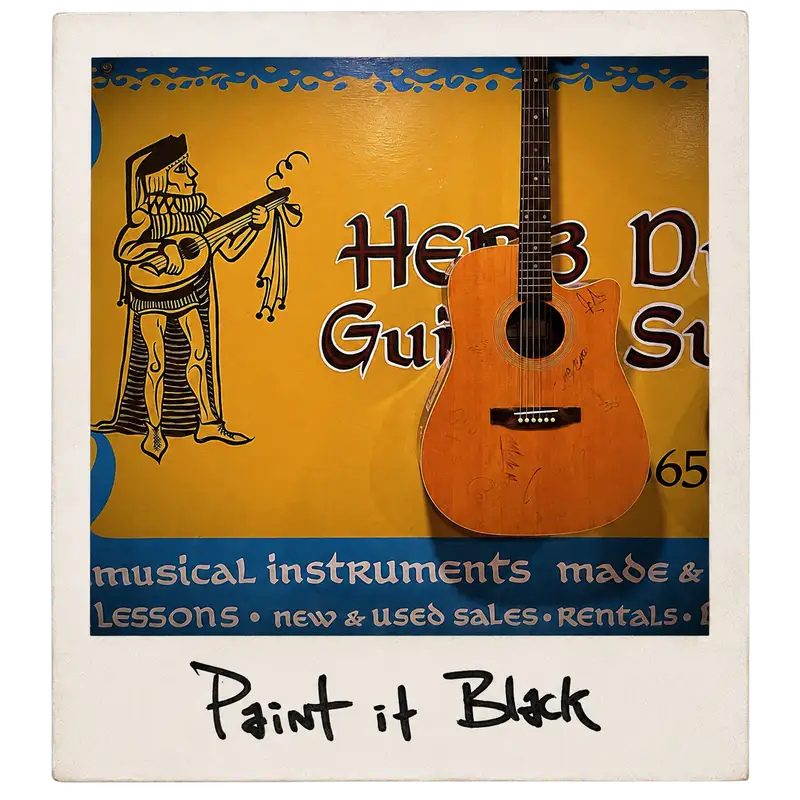
Paint it Black
My old acoustic has seen better days. It’s seen worse too.
These days it mostly just hangs on the wall in our basement, collecting dust.
It sits against the backdrop of an old hand-painted sign, gold and baby blue - the original Herb David Guitar sign. The same one that hung for decades on the front porch of the legendary Ann Arbor guitar studio. The same sign I sat under as a kid, waiting for rides after lessons.
Same old sign, same old guitar.
A steel-string acoustic with a cutaway - blonde and mahogany. It used to have an electric pickup, but that fell apart years ago.
The plug still hangs inside the cavern of the guitar’s body, disconnected.
Faded autographs of old friends grace the front. There is a divot along the underside of the neck - a battle scar. This guitar has seen some shit.
A broken string hangs down the front, tarnished and dull. A thin blanket of dust has accumulated across all ledges, like the first snow of winter.
It has always been a beast, requiring tough fingers and a little extra muscle to hammer those strings down into place. I would spend hours up in my bedroom, fumbling through chords and scales, trying to make sense of it.
I knew I’d never be a virtuoso, but the dream was always there. Ever since I heard a rock and roll song as a kid that made me pause long enough to wonder, what is this?
I wasn’t much older than my son Teddy is now, four at most. These days, when I hear that song, it pulls me right back into the whole furnished memory.
The year was 1987, and I was in preschool.
I had made a few friends there, and one good one. His name was Tripp, short for John Henry the Third.
His mom liked to say we were “first friends,” and there’s a picture to prove it.
The two of us are standing in a doorway, dressed up like cowboys - suede vests with sherpa lining, and wide-brimmed hats. We’ve each got one of the other’s shoes on. Because when you’re four, that’s what friends do.
One day after preschool, we were up in Tripp’s bedroom, and he had a little tape player and a cassette of some old songs. I didn’t know what they were - I just knew they were old, and they sounded…different. Not like the soft rock radio station that my mom played in the van. This was not 100.3 WNIC.
Then I heard my song, and I stopped whatever I was doing to listen. The opening riff, the pounding drum, the vaguely eastern melody. Dark psychedelic energy.
I see a red door and I want it painted black
There was something dangerous and powerful about this tune, and it pulled me in. The haunting lyrics. The driving rhythm of tightly wound rock and roll. It sounded like something not meant for my ears.
That old Stones song lit a spark.
When we were kids, my dad drove a Lincoln Towncar - two tons of Detroit muscle that floated like a boat down the highway.
He had a compilation CD of sixties bands that he would play over the car stereo as we rode around town. He would quiz me on the songs.
“Who’s this one?” he’d ask after the first few notes of “Happy Together” trickled through the speakers.
“The Turtles!” I’d answer, and the quiz would go on.
I would dig through my oldest brother Brian’s collection of cassettes - Guns n Roses, Red Hot Chili Peppers, Beastie Boys. I dubbed copies of my own and played them on my Walkman.
I never sang along.
Some households are full of song. Parents sing to children, and the children carry on. In our house, the music was always there - just not from our voices.
In grade school, the music teacher kept me after class one day.
She knew I was just mouthing the words while the other kids sang along.
As I stood next to the upright piano, the teacher sat at the bench and tapped out a note. It echoed through the empty music room.
“Sing this note,” she demanded.
I refused.
Something in me stifled.
In middle school, my bedroom walls were plastered with posters of the greats; Jimi Hendrix, Grateful Dead, and my own pencil sketch of Mick Jagger nursing a bottle of Jack Daniels backstage.
For Christmas one year, I got my first guitar - that same old beast. My hands stretched across chords, and my fingertips callused.
I kept practicing, and slapped a bright red Rolling Stones lips sticker on the front.
I learned some chords, and I could run through some scales. But still, I did not sing.
It wasn’t until years later, when I fell in love with alcohol that I finally found my voice.
One summer I let it all go.
Complete and untethered freedom.
Alcohol unlocked something in me, and I started singing.
Just a few basic chord changes and melodies - Beatles, Johnny Cash, the Stones. Nothing crazy. But I was singing, and it felt good.
I thought I had finally found the answer.
It’s not easy facing up, when your whole world is black
We were living out past the orange groves north of Orlando, in a little lakeside town called Howey-in-the-Hills. When the orange blossoms bloomed, the fragrance in the air was light and sweet, like an Orange Creme soda. It was pretty country, with lots of backroads to get lost on.
I had it all figured out: a four-pack of tall boys was the perfect amount of beer for my half hour drive to work.
I was bartending at a country club - an alcoholic’s dream.
Pre-shift beers turned into heavy-handed gin and tonics behind the bar. I snuck drinks when and wherever I could.
Most of my days were spent at home with Henry. In the mornings, I would make him eggs and toast. We’d go for a swim in the pool and walks in the stroller.
Across the street from our house was a dock that stretched out over a lake. The wooden boardwalk was flanked by banana trees on either side. Some days we would sit at the end of the dock and watch for alligators and snapping turtles.
We had rented a ranch with a Florida room and a swimming pool on the back. $1100 a month for our own little slice of paradise.
The house was all hardwood floors, and Henry would ride around the living room in his Little Tikes police car, pushing with his feet, Flintstones style. The little toy license plate on the back read, “Henry J.” Florida - the Sunshine State.
The heat and humidity were brutal, but the grass still needed cutting. If I couldn’t get the whole lawn mowed during Henry’s naptime, I would set his Pack n Play outside, and he would sit in there, watching me push the mower back and forth across the yard.
At age two, Henry was my best friend.
One year we got a hefty tax return. I spent most of it on a 2000 Jeep Cherokee - patriot blue. I loved that car.
Henry’s mom wanted a ring. I didn’t even have a valid license.
One day on the drive to work, I spun out. The roads were slick after a rain, my tires were bald.
The Jeep did a 180. I wrestled with the steering wheel and slammed on the brakes. The car rocked right and then left, jerking to a complete halt in the grass on the side of the road, inches away from the thick trunk of a tall oak tree.
I looked out over the steering wheel, facing the opposite direction. My heart raced. I caught my breath and drove on, stopping for beer along the way.
Henry’s mom and I had reached a breaking point.
“You want me gone?” I yelled. I already knew the answer.
“Fine,” I said. “I’m outta here.”
A few days later, I was on a plane to Asheville.
It was Leaf Season in the Blue Ridge Mountains. People come from all over to see the fall colors. The locals call them “Leaf Peepers,” as in “oh great, the Leaf Peepers are here again.”
My brother Greg had been living in a shed behind the house of some musician friends. He and Fiona were moving in together, and Greg let me take over the shed. $225 a month for electricity, internet, and a mini fridge.
I had just arrived from Florida, and I was in exile.
The guys in the main house called the shack out back The Annex. They didn’t like when I tracked leaves in the house, but for the most part, we got along great.
They could always count on me to have cold beer in the mini fridge.
Greg had left me a stereo and an old stack of records.
For days I sat in the shed drinking Budweiser out of cans and listening to Billy Joel’s The Stranger on repeat.
“You should give The Stranger a rest," Greg said one afternoon. “Get some fresh air.”
I got a job bartending at a barbecue place downtown, and I fell into the familiar rhythm of working and drinking.
Aside from the endless supply of alcohol, the best part about the job was that I got to play DJ. On Sundays, I would run a regular program of classic country tunes. Hillbilly Sunday, I called it. Songs like “Choctaw Bingo” and “Long-Haired Redneck” became staples. Townes Van Zandt was a favorite.
I had brought my old guitar with me, and I started playing again. Back at the shed I would sit out on the deck behind the house and run through some old songs.
One day I worked out the chords to “Paint it Black,” and it became something new, and different.
I slowed it down, and the driving rhythm of the original became a slow drawl. Keith Richards’ electric guitar turned into a country ballad on my old acoustic. The forlorn lyrics sang like an old cowboy tune.
One afternoon, Rahm - one of the guys from the house, joined me on the back deck.
“I like that “Paint it Black,”” he said. “It sounds good.”
Rahm was a real musician, and a damn good guitarist. I wasn’t sure if he meant it, but I took the compliment.
“I don’t love my voice,” I told him.
Rahm shrugged. “You just gotta do it,” he said. “Look at Dylan.”
He was right. Some of our greatest troubadours were not great singers. But their voices were true, their songs sacred.
Autumn swept through Asheville, and the leaves fell from the trees. It was the season between fall and winter, when nature shuts everything down. What Kurt Vonnegut calls, “Locking.” The time between.
Nights in the shed grew colder.
I missed Henry.
It had been almost four months since I left Florida, and Christmas was coming soon. It was time to head back.
When I walked into the house, Henry didn’t see me at first. I stood in the doorway and watched him play for a minute. Then he looked up.
“Dada,” he whispered, as if he couldn’t quite believe it.
He hadn’t forgotten me.
I scooped him up, and held on for a long time.
I was a dad again.
Henry’s mom and I tried to put our little family back together, but we couldn’t make the pieces fit.
Florida was not the paradise we had dreamed of, and we both agreed - it was time to move back to Michigan.
We rented a big yellow Penske truck, loaded up, and headed north. I drove the moving truck, Henry and his mom followed in her car.
As we passed through Ohio and into Michigan, the road split. I headed west for Ann Arbor, she went east toward Detroit. Through the windshield of the truck, I watched as her car drove off into the distance.
My life as a single dad back in Michigan developed its own rhythm. I worked, I drank, and I took care of Henry.
As he got older, I managed my drinking. It was subdued.
I got Henry started on guitar. That same old acoustic I got for Christmas years ago. The bright red Rolling Stones lips sticker was long gone, but it was still a beast to play, and a good one to learn on.
I showed Henry some chords, and a few scales, and signed him up for lessons.
Guitar was a starting point for Henry, but eventually he found his groove with the saxophone, just like his Uncle Greg.
They started doing lessons together, and Henry was a natural.
At a certain point, Greg said Henry had surpassed his level of teaching.
Next year Henry’s off to college, to study music and play in the marching band.
That old acoustic still hangs on the wall in our basement. Lately, I have felt the draw to pick it up again.
I buy a fresh pack of strings - Ernie Ball, bronze. It’s time to breathe some new life into this old guitar.
I pull it down off the wall, away from the old hand painted sign, and start loosening the strings, turn by turn, plucking as I go so I can hear the pitch drop lower and lower.
I pull the pegs and strip away the old dull strings, wiping away the dust.
The new strings are bright and clean, they uncoil from their sleeves as I open the pack. I thread them through and tighten it down.
Once they are all in place, I tune the guitar by ear, let it settle, and tune again.
E minor to B7 - that’s how my version of “Paint it Black” starts.
The first chord rings out bright and true, and the words are still there.
I haven’t lost my voice.